
Chino cloth is a specific, refined variety of cotton twill. While cotton twill encompasses all diagonal-rib fabrics across weights from 4.0 to 16.0+ oz/yd², authentic chino cloth is strictly a midweight (6.0 to 8.5 oz/yd²), combed cotton, steep-wale twill featuring a smooth, mercerized finish engineered for apparel.
Commercial textile procurement requires exact differentiation between general weave categories and specialized finished yardage. The table below outlines the primary performance characteristics dividing authentic chino cloth from the broad cotton twill spectrum:
| Performance Dimension | Authentic Chino Cloth | General Cotton Twill Envelope | Diagnostic Significance |
|---|---|---|---|
| Taxonomic Classification | Species (Specialized Apparel Subclass) | Genus (Parent Textile Weave Architecture) | Chino is a subset of twill; twill is the broader parent category. |
| Areal Mass (Weight) | 6.0 to 8.5 oz/yd² (203 to 288 GSM) | 4.0 to 16.0+ oz/yd² (135 to 542+ GSM) | Chino is strictly midweight; generic twill spans shirting to bull denim. |
| Yarn Type & Count | Combed ring-spun cotton (Ne 20/2 to 30/2) | Carded, open-end, or ring-spun (Ne 6/1 to 40/2) | Combing removes short fibers, producing chino’s smooth face. |
| Weave Float Architecture | 3/1 steep warp-faced twill float | 2/1, 2/2 balanced, 3/1, broken twill, herringbone | Steep float concentrates warp yarns on the face to maximize sheen. |
| Diagonal Wale Angle | 63° steep diagonal wale line | 15° to 75° depending on warp-to-weft yarn ratio | Chino features a subtle, compact diagonal ridge rather than coarse ribs. |
| Surface Finish & Luster | Gas singed, caustic mercerized, sanforized | Raw loomstate, unbrushed, brushed, or standard dyed | Mercerization swells cotton lumens, imparting a silky luster. |
| Cusick Drape (DC%) | 38% to 44% (Fluid, multi-nodal drape) | 30% to 68% across the full weight spectrum | Twill floats allow yarns to glide, creating soft garment silhouettes. |
| AATCC 66 Crease Angle | 208° to 220° (Pure Cotton), 260°+ (Blends) | 190° to 265° depending on weight and fiber blend | Diagonal float dispersion yields superior wrinkle recovery over plain canvas. |
| Primary Commercial Uses | Tailored trousers, chinos, blazers, uniforms | Apparel, workwear, slipcovers, upholstery, bags | Chino targets refined apparel; twill serves industrial and apparel needs. |
In commercial textile procurement, confusing chino cloth with general cotton twill creates costly manufacturing errors. At Canvas ETC, our production floor often receives inquiries from designers asking whether they should specify “chino” or “twill” for trousers, jackets, or accessories. The answer begins with a clear taxonomic principle: chino cloth and cotton twill do not compete as separate weave categories. Chino cloth is an exact species within the overarching cotton twill genus.
Every yard of authentic chino cloth is cotton twill, but cotton twill encompasses a much broader spectrum of fabric weights, yarn counts, float architectures, and surface treatments. Understanding where chino sits within the wider twill family allows fabricators to select the correct specification for their production run, whether they need fluid drape for apparel or rigid tensile strength for industrial upholstery. For fabricators comparing twill structures against plain-weave fabrics, our duck canvas vs twill analysis provides a direct structural comparison.
Twill weave represents one of the three foundational interlacing systems in textile engineering, alongside plain weave and satin. The defining mechanical characteristic of all twill textiles is the presence of diagonal parallel ribs, termed wales, across the face of the fabric.
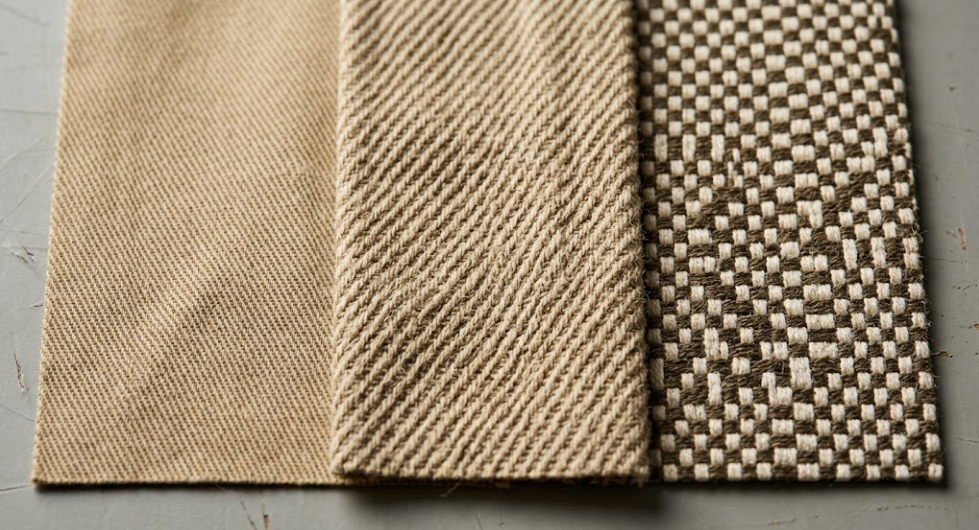
Weavers produce this diagonal pattern by passing the weft yarn over one or more warp yarns and then under two or more warp yarns, staggering the interlacing points by one thread on each successive pick. This stepped offset creates a continuous diagonal wale angle. Because twill yarns float across multiple opposing threads before interlacing, twill fabrics have significantly fewer yarn crossover points per square inch than plain-weave textiles such as dyed duck numbered canvas fabric.
This reduced interlacing frequency gives cotton twill distinct mechanical advantages:
Under the cotton twill umbrella, you will find textiles as varied as lightweight 4.5 oz shirting twills, 8.5 oz industrial utility drills, 10.5 oz denim with indigo warp yarns, 12 oz piece-dyed bull denim, and heavy 14 oz structural upholstery twills.
Chino cloth is not a generic twill. It is a highly specialized, compact, midweight variety of cotton twill engineered specifically for apparel. Historically developed for military uniforms in the late 19th century and popularized by returned service members on American university campuses, chino cloth was designed to satisfy three strict operational requirements:
To achieve these properties, textile mills established precise manufacturing parameters that separate authentic chino cloth from generic utility twill:
The tactile and physical differences between chino cloth and other cotton twills stem directly from loom geometry, yarn preparation, and chemical finishing. When examining swatches under a textile microscope, these structural differences become immediately apparent.
The interlacing repeat pattern determines how light reflects off the fabric face and how yarns flex under movement:
Yarn selection represents the primary quality dividing line between fine chino cloth and coarse workwear twill:
To convert and compare yarn counts across metric and imperial systems, utilize our ounces per square yard to GSM converter.
Chino cloth achieves its signature refined hand through an intensive post-weaving finishing protocol that utility twills typically bypass:
Generic cotton twills, by comparison, often receive only a basic scour and piece dye, retaining their natural surface fuzz, matte luster, and higher residual shrinkage.
To evaluate the mechanical differences between chino cloth, utility twills, bull denim, and plain canvas duck, we conducted standardized physical testing in our quality-assurance testing facility. All specimens were conditioned for 24 hours in accordance with ASTM D1776 at 70 ± 2°F (21 ± 1°C) and 65 ± 2% relative humidity prior to testing.
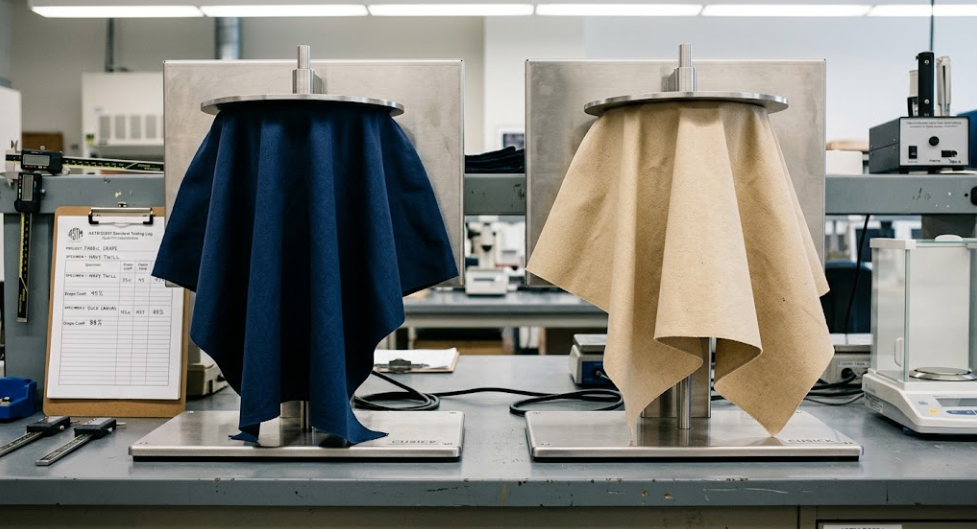
The comparative matrix below documents the mechanical metrics across five distinct twill grades from our commercial catalog alongside a plain-weave cotton duck control of identical mass:
| Specimen Identification | Areal Mass (oz/yd² / GSM) | Construction & Fiber | Weave Architecture | ASTM D5034 Grab Tensile (Warp x Weft) | ASTM D1424 Elmendorf Tear (Warp x Weft) | ASTM D1388 Bending Length (c, Warp) | Cusick Drape (DC%) | AATCC 66 Crease Angle (CRA) | AATCC 128 Wrinkle Grade |
|---|---|---|---|---|---|---|---|---|---|
| Specimen A: Combed Cotton Chino Twill | 7.5 oz / 254 GSM | Ne 20/2 Combed Ring-Spun (100% Cotton) | 3/1 Steep Twill (63° Wale) | 118 lbf x 68 lbf | 6.8 lbf x 5.9 lbf | 2.8 cm | 41% | 212° | Grade 3.2 |
| Specimen B: Commercial Uniform Chino | 7.5 oz / 254 GSM | Ne 20/2 Blended (65% Poly / 35% Cotton) | 3/1 Steep Twill (63° Wale) | 164 lbf x 94 lbf | 11.4 lbf x 9.8 lbf | 2.7 cm | 39% | 264° | Grade 4.4 |
| Specimen C: Carded Cotton Utility Drill | 8.5 oz / 288 GSM | Ne 14/1 Carded Open-End (100% Cotton) | 3/1 Regular Twill (45° Wale) | 132 lbf x 74 lbf | 8.2 lbf x 7.1 lbf | 3.8 cm | 52% | 204° | Grade 3.0 |
| Specimen D: Heavy Commercial Bull Denim | 12.0 oz / 407 GSM | Ne 10/1 Ring-Spun (100% Cotton) | 3/1 Warp-Faced (45° Wale) | 178 lbf x 92 lbf | 16.4 lbf x 13.9 lbf | 5.2 cm | 64% | 222° | Grade 3.6 |
| Specimen E: Lightweight Shirting Twill | 5.0 oz / 170 GSM | Ne 36/1 Combed Ring-Spun (100% Cotton) | 2/1 Regular Twill (45° Wale) | 74 lbf x 48 lbf | 3.8 lbf x 3.2 lbf | 2.0 cm | 29% | 218° | Grade 3.1 |
| Control: #10 Single Fill Cotton Duck Canvas | 7.5 oz / 254 GSM | Ne 20/2 Carded Plain Grid (100% Cotton) | 1/1 Plain Weave (Orthogonal) | 112 lbf x 65 lbf | 5.2 lbf x 4.6 lbf | 4.2 cm | 68% | 174° | Grade 2.2 |
Note: For comparison testing with midweight plain canvas, fabricators frequently evaluate our 7 oz wheat canvas fabric, which provides a stable baseline for plain-weave rigidity.
Bending length (c) measured under ASTM D1388 directly determines how a textile conforms to the human body or drapes over furniture. Flexural rigidity increases as the cube of the bending length.
Our empirical testing reveals striking performance differences between chino cloth and plain canvas:
These metrics demonstrate why chino cloth is chosen for comfortable trousers and blazers. The 3/1 steep twill floats allow adjacent yarns to articulate and glide over one another under gravitational force, eliminating the cardboard-like rigidity inherent to plain weaves. For deeper mathematical models of drape flow, explore our technical guide on twill drape and wrinkle recovery mechanics.
Wrinkle formation occurs when external folding forces exceed the elastic yield point of the cotton fibers, breaking hydrogen bonds within the amorphous regions of the cellulose polymer chains. When pressure is released, the broken bonds reform in the bent state, creating a permanent crease.
Twill weave mitigates this creasing mechanism through structural stress dispersion:
A frequent source of confusion among fabric buyers is the relationship between chino and khaki. The terms are often used interchangeably in retail marketing, yet in textile history and materials science, they represent two completely different concepts:
The historical root of khaki uniforms began in 1848 in Peshawar, on the northwestern frontier of British India. Lieutenant Harry Lumsden, commanding the newly formed Corps of Guides, recognized that the traditional British red wool tunics and white cross-belts made soldiers unmistakable targets against the arid, rocky landscape.
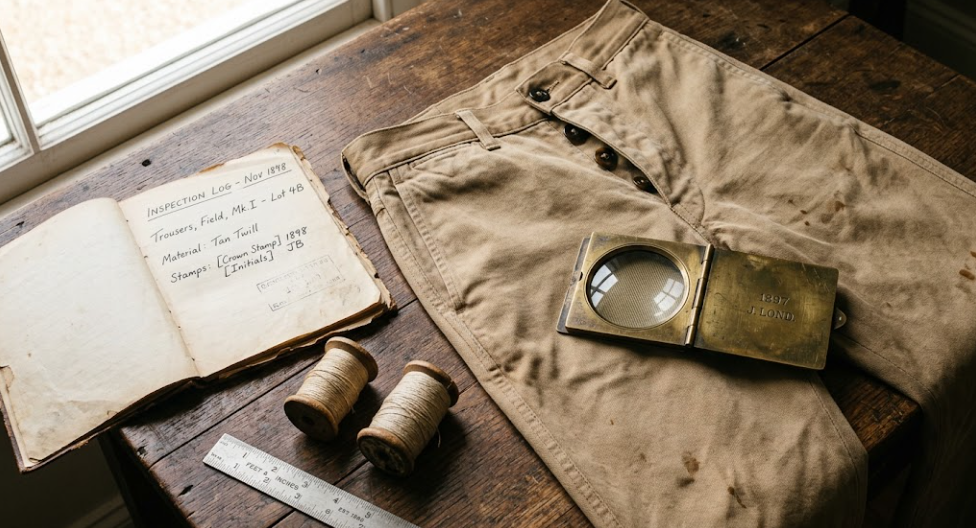
Lumsden had native cotton fabric dyed locally using river mud, tea leaves, and native mulberry plant extract, creating a dull tan shade that matched the dusty terrain. The local troops named the color khaki, derived from the Persian and Urdu word khak, meaning “dust” or “earth-colored.” Khaki was adopted as field dress across British colonial units and eventually became standard issue for the entire British Army during the Second Boer War (1899 to 1902). In this historical context, khaki was solely a color and military camouflage strategy; the underlying fabric varied between plain-weave cotton poplin, linen drill, and wool serge. For authentic military gear and historic tentage, Canvas ETC continues to supply traditional 10 oz army duck canvas.
The origin of chino cloth as an explicit textile name occurred 50 years later during the Spanish-American War of 1898 in the Philippines. American expeditionary soldiers arrived in tropical Manila wearing standard-issue heavy blue wool flannel uniforms, which proved disastrously hot and debilitating in the humid jungle environment.
Seeking relief, US Army quartermasters and individual soldiers procured lightweight, durable cotton twill uniforms from local trading merchants in Manila. This fabric was manufactured in Chinese textile mills and imported through regional maritime trade routes. Because the cloth originated in China, the Spanish-speaking Filipino merchants referred to the fabric as chino, the Spanish word for “Chinese.”
The trousers made from this Chinese cotton twill featured a steep 3/1 weave float, high thread count, and a smooth, unpleated cut designed to conserve yardage. When US veterans returned home to California and New York following the war, they brought their durable uniform trousers with them, referring to them as “chinos.”
Following World War II, millions of returning service members enrolled in colleges under the GI Bill, wearing their government-issue khaki-colored chino twill pants to classes. This cemented “chinos” as a permanent American apparel staple. Thus, while your chino trousers may be khaki in color, they can also be dyed navy, black, olive, or white. Khaki is the color; chino is the twill weave.
Because cotton twill spans such a broad spectrum of weights, fabricators must select the appropriate textile specification based on the mechanical demands of the finished product.
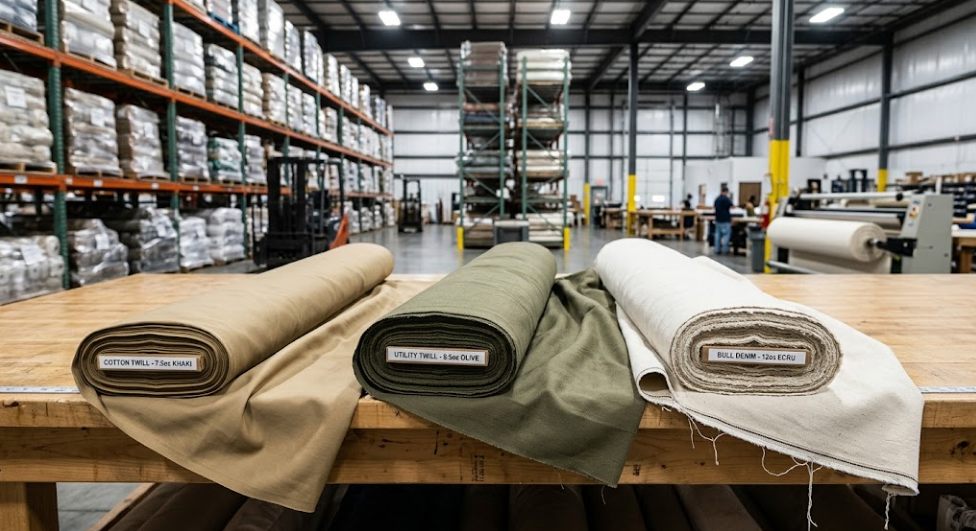
In apparel production, the choice between chino cloth and standard utility twill dictates garment styling, comfort, and target retail positioning:
For a comprehensive review of weight classifications across all twill categories, consult our master cotton twill fabric weights guide.
Beyond trousers, twill textiles play an essential role in commercial hospitality and interior fabrication:
The following real-world case studies from our commercial converting and cut-and-sew accounts illustrate how selecting the correct twill specification impacts product longevity and client satisfaction.
Commercial Client Profile: A regional uniform manufacturer supplying service trousers for commercial fleet delivery drivers and corporate field technicians across the United States (annual production: 45,000 units).
The Operational Challenge: The client originally manufactured trousers using an 8.5 oz carded open-end utility twill. While the pants met baseline tensile specifications, drivers complained of severe stiffness and abrasive chafing during seated driving. In ongoing service trials, after 25 to 30 commercial laundry cycles (140°F wash, tunnel air-dry), the carded twill developed prominent surface fuzz and fiber pills across the inner thighs and pocket welts, degrading the corporate uniform appearance.
Canvas ETC Technical Intervention: We recommended transitioning the uniform program to our 7.5 oz commercial uniform chino twill (Specimen B: 65% polyester / 35% combed cotton, 3/1 steep twill, Ne 20/2 yarn). We provided sample yardage for prototype garment testing and conducted a controlled 50-cycle commercial laundry trial.
Observed Production Results:
Commercial Client Profile: A boutique hospitality apparel brand producing high-end bib aprons and service jackets for an upscale national restaurant chain with 32 locations.
The Operational Challenge: The client previously specified a standard 10 oz plain cotton duck canvas. While visually authentic, restaurant waitstaff reported that the stiff bib fabric pulled uncomfortably against the back of the neck during 8-hour shifts. Additionally, after 30 commercial dishwashing and laundry cycles, the plain-weave canvas developed severe white edge frosting (surface dye abrasion) along the folded apron hems and neck ties.
Canvas ETC Technical Intervention: We transitioned the apron production line to our 8.0 oz combed cotton chino cloth, piece-dyed in deep midnight navy and finished with caustic mercerization and sanforization.
Observed Production Results:
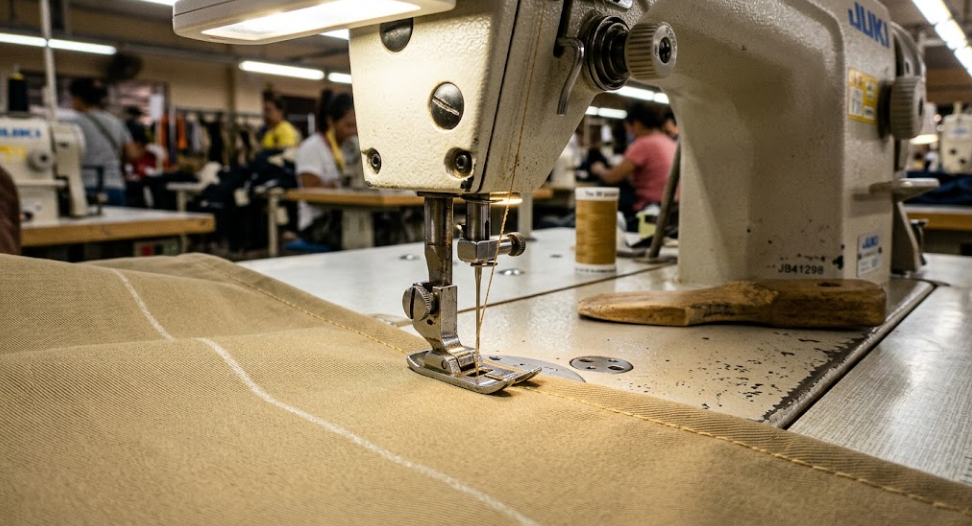
Achieving clean, professional results with chino cloth in commercial cutting and sewing operations requires specific machine adjustments. Because chino twill features high thread density and tightly packed warp floats, improper needle selection or thread tension can cause needle cut, seam puckering, or premature stitch failure.
| Fabric Category | Areal Mass (oz/yd² / GSM) | Recommended Needle System & Size | Recommended Thread Ticket | Stitch Density (SPI) | Presser Foot & Tension Notes |
|---|---|---|---|---|---|
| Lightweight Shirting Twill | 4.5 to 6.0 oz / 152-203 GSM | Schmetz 134R Size 75/11 to 80/12 (Regular Round / R) | Tex 24 to Tex 27 Core-Spun Poly | 12 to 14 SPI | Light foot pressure; balanced low thread tension to prevent puckering. |
| Fine Combed Chino Cloth | 6.0 to 8.5 oz / 203-288 GSM | Schmetz 134R Size 80/12 to 90/14 (Light Ball Point / SES) | Tex 30 to Tex 40 Core-Spun Poly | 10 to 12 SPI | Medium foot pressure; SES ball point deflects dense warp floats without cutting. |
| Carded Utility Drill Twill | 7.5 to 10.0 oz / 254-339 GSM | Schmetz 134R Size 90/14 to 100/16 (Regular Sharp / R) | Tex 40 to Tex 60 Spun or Core Poly | 9 to 11 SPI | Medium-heavy foot pressure; differential feed set neutral to prevent creeping. |
| Heavy Bull Denim Twill | 10.0 to 14.0 oz / 339-475 GSM | Schmetz 134R Size 100/16 to 110/18 (Regular Sharp / R) | Tex 60 to Tex 80 Heavy Core-Spun | 8 to 10 SPI | Heavy presser foot pressure; walking foot or compound feed recommended. |
| Plain Cotton Duck Canvas | 7.0 to 15.0 oz / 237-509 GSM | Schmetz 134R Size 100/16 to 120/19 (Wedge / Sharp) | Tex 60 to Tex 105 Bonded Poly / Nylon | 6 to 8 SPI | Heavy foot pressure; walking foot mandatory for multi-ply seam crossings. |
Chino cloth is not a separate competing weave; it is an exact species within the broader cotton twill genus. While cotton twill spans all diagonal-wale fabrics from 4.0 to 16.0+ oz/yd², authentic chino cloth is strictly a midweight (6.0 to 8.5 oz/yd²), combed ring-spun cotton twill with a steep 3/1 float and a smooth mercerized finish.
The distinction lies in tailoring, fabric weight, and surface texture. Chinos are tailored trousers constructed from smooth, combed, midweight chino twill (6.0 to 8.5 oz/yd²) with slant pockets, welted back pockets, and minimal external topstitching. General twill pants frequently feature heavier, carded workwear twills or bull denim (8.5 to 12.0+ oz/yd²) with 5-pocket jean styling, reinforced rivets, and rugged double-stitched flat-felled seams.
Authentic commercial chino cloth operates within a defined midweight boundary between 6.0 and 8.5 oz/yd² (203 to 288 GSM). Fabrics lighter than 6.0 oz lack the opacity required for bottom-weight trousers, while twill fabrics exceeding 8.5 oz transition into heavy utility drill or workwear twill.
Chino cloth resists sharp permanent creasing significantly better than plain duck canvas. In standardized AATCC 66 laboratory testing, 7.5 oz chino twill achieves a Crease Recovery Angle of 212 degrees compared to 174 degrees for identical-weight plain duck, because its stepped diagonal floats redistribute folding stress across adjacent yarns rather than pinching at rigid crossover points.
Industrial apparel fabricators recommend Schmetz size 80/12 to 90/14 light ball point (SES) needles to penetrate compact 3/1 warp floats without severing yarns. Seams should be assembled using Tex 30 to Tex 40 core-spun polyester thread calibrated to 10 to 12 stitches per inch.
Choosing between chino cloth, utility twill, bull denim, and cotton duck canvas depends entirely on your product’s performance tolerances, tactile requirements, and target manufacturing budget.
At Canvas ETC, we partner with independent designers, cut-and-sew contractors, corporate uniform brands, and commercial upholstery manufacturers across the United States. Our warehouse facility maintains comprehensive inventory across all core textile categories:
Before committing to full production rolls, evaluate hand feel, drape, and stitch compatibility in your facility. We offer cut-yard sample lengths and comprehensive swatch packs with rapid domestic fulfillment.Order Printed Fabric Swatches and Samples