
Canvas projects for Thanksgiving encompass functional cut-and-sew dining textiles, weather-resistant culinary carriers, and archival holiday wall art built from specification-grade woven cotton duck ranging from 7 oz single-fill plain weave (237 GSM) to 18 oz Number 8 plied duck (610 GSM). Selecting the exact fabric weight, width, weave, finish, and surface coating prevents shrinkage, gravy staining, and seam failure.
Engineered for home makers, independent brands, commercial manufacturers, and institutional hospitality buyers, this guide details twelve Thanksgiving builds alongside honest comparisons with flax linen, marine acrylic, 1050D ballistic nylon, and 70D ripstop nylon. In 2026 relaxation-shrinkage trials conducted per AATCC Test Method 135 at our Auburn, Georgia textile facility across 30 cotton duck specimens, unwashed 10 oz greige single-fill cotton duck contracted by 6.8% in the warp and 3.4% in the weft after one 120°F laundering cycle, whereas pre-shrunk and damp-squared yardage held dimensional variance under 0.9%.
Matching all seven textile specification parameters—material composition, areal weight (oz/sq yd and GSM) or yarn denier, bolt width, weave geometry, mill finish, surface coating, and target end use—determines whether a Thanksgiving project lies flat across a banquet table, repels acidic cranberry spills, or supports 45 pounds of split hickory firewood. Most holiday DIY guides fail because they treat “canvas” as a single generic craft fabric, ignoring the structural difference between a pliable 7 oz single-fill cotton duck (237 GSM) and a rigid 18 oz Number 8 plied cotton duck (610 GSM).
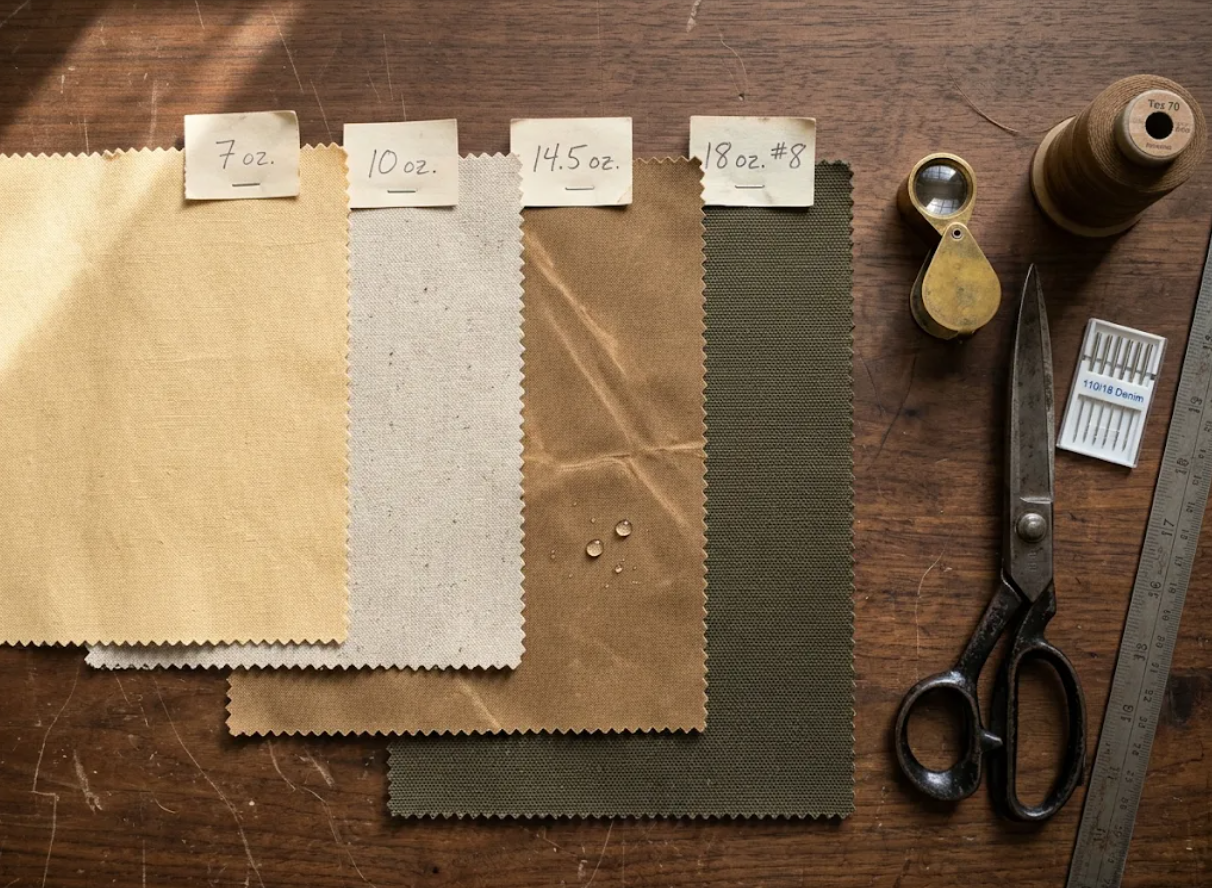
As a wholesale fabric supplier and custom textile-production partner in Auburn, Georgia, we evaluate every holiday project substrate using ASTM D3776 mass-per-unit-area standards ($1\text{ oz/sq yd} = 33.9057\text{ GSM}$). Single-fill ounce ducks weave two warp yarns over a single weft yarn in a 1×1 plain weave, delivering supple drape for table runners, placemats, and stenciled banners. Numbered ducks (#12, #10, #8) and two-ply Army Ducks use multi-ply twisted cotton yarns in both warp and weft directions, creating dense basket-plain weaves for freestanding bread warmers, insulated pie totes, and wide-format archival wall scrolls. Whether you are ordering fabric swatches, cut yardage for a home dining room, or full-roll purchasing paired with our in-house digital fabric and wallpaper printing, precision roll slitting, custom coloring, pattern digitizing, and cut-and-sew finished goods, Table 1 maps the exact specification for each build.
| Project Build | Material | Weight or Denier | Width | Weave | Finish | Coating | End Use |
|---|---|---|---|---|---|---|---|
| 1. Mitered Table Runner | 100% Ring-Spun Cotton | 10.0 oz/sq yd (339 GSM) | 63 in | 1×1 Single-Fill Plain Weave | Unbleached Natural Greige (Pre-Shrunk) | Uncoated Breathable Cellulose | 108-in Thanksgiving dining table centerpiece runner |
| 2. Printed Botanical Placemats | 100% Ring-Spun Cotton | 10.0 oz/sq yd (339 GSM) | 58–60 in | 1×1 Single-Fill Plain Weave | Scoured & Optical-Free Bleached | Heat-Cured Digital Pigment Ink | Washable holiday place settings and keepsake menu cards |
| 3. Spill-Resistant Chair Slipcovers | 100% Plied Cotton | 14.73 oz/sq yd (#10 Duck, 500 GSM) | 59 in | 2×2 Plied Numbered Basket-Plain Weave | Vat-Dyed Autumn Colorfast | Water-Repellent & Antimicrobial (WRAM) | Dining room chair protection against gravy and wine spills |
| 4. Structured Bread Basket | 100% Plied Cotton | 18.0 oz/sq yd (#8 Duck, 610 GSM) | 58–60 in | Multi-Ply Numbered Basket-Plain Weave | Unbleached Natural or Vat-Dyed | Uncoated Steam-Breathable | Freestanding dinner roll and sourdough warming basket |
| 5. Insulated Pie & Casserole Tote | 100% Combed 2-Ply Cotton | 10.10 oz base / 14.5 oz waxed (492 GSM) | 60 in | Tight Two-Ply Army Duck Plain Weave | Vat-Dyed Field Tan | Paraffin & Beeswax Impregnated | Weather-resistant transport for 9-in pies and 9×13-in dishes |
| 6. Two-Bottle Holiday Wine Bag | 100% Combed 2-Ply Cotton | 10.10 oz base / 14.5 oz waxed (492 GSM) | 60 in | Tight Two-Ply Army Duck Plain Weave | Vat-Dyed Oak, Olive, or Charcoal | Paraffin & Beeswax Impregnated | Padded two-bottle host gift carrier for wine or cider |
| 7. Hearth Firewood Log Tote | 100% Plied Cotton | 18.0 oz/sq yd (#8 Duck, 610 GSM) | 58 in | Multi-Ply Numbered Basket-Plain Weave | Vat-Dyed Olive Drab or Navy | Uncoated Spark-Char Resistant | Hauling 35–50 lb hardwood loads from woodpile to hearth |
| 8. Chef’s Carving Apron | 100% Ring-Spun Cotton | 12.0 oz/sq yd (407 GSM) | 59 in | 3×1 Right-Hand Bull Denim Twill | Sanforized & Brushed Face | Uncoated Body / Waxed Duck Pockets | Heat-buffering and splatter-resistant turkey carving apron |
| 9. Family Gratitude Wall Scroll | 100% Plied Cotton | 11.5 oz/sq yd (#12 Duck, 390 GSM) | 72 in | 2×2 Plied Numbered Artist Weave | Unprimed Natural Loom-State | Clear Archival Acrylic Polymer Size | Oversized hanging scroll for dated annual family notes |
| 10. Botanical Harvest Triptych | 100% Plied Cotton | 14.73 oz/sq yd (#10 Duck, 500 GSM) | 72 in | 2×2 Plied Numbered Artist Weave | Raw Stretched on 1.5-in Bars | Triple-Coat Titanium Acrylic Gesso | Three-panel archival acrylic or oil harvest gallery wall art |
| 11. Stenciled Harvest Porch Banner | 100% Ring-Spun Cotton | 7.0 oz/sq yd (237 GSM) | 60 in | 1×1 Single-Fill Plain Weave | Vat-Dyed Wheat or Natural | Heat-Set Screen Ink / Clear Sealer | No-sew mantel bunting and vertical porch welcome signage |
| 12. Kids’ Keepsake Handprint Panel | 100% Plied Cotton | 11.5 oz/sq yd (#12 Duck, 390 GSM) | 60 in | 2×2 Plied Numbered Artist Weave | Laminated on 0.75-in Birch Cradle | pH-Neutral PVA & Triple Acrylic Gesso | Rigid archival mixed-media panel for children’s handprints |
Using Table 1 as a pre-purchase specification checklist prevents the two most costly holiday fabrication mistakes: selecting stiff plied numbered duck for draped table linens that refuse to miter cleanly, or choosing lightweight 7 oz single-fill duck for load-bearing carriers that fail at the handle seams.
Cut-and-sew and custom-printed Thanksgiving tabletop projects perform best when built from 10 oz single-fill cotton duck (339 GSM) for flat-lying runners and placemats, 14.73 oz #10 water-repellent duck (500 GSM) for dining chair slipcovers, and 18 oz #8 plied duck (610 GSM) for freestanding bread baskets. Unlike lightweight 4 oz cotton poplin that slides across polished wood tables or synthetic satin that snags on serving utensils, medium-to-heavyweight cotton duck provides high surface friction and natural thermal insulation.
Material: 100% Ring-Spun Cotton | Weight: 10.0 oz/sq yd (339 GSM) | Width: 63 in | Weave: 1×1 Single-Fill Plain Weave | Finish: Unbleached Natural Greige | Coating: Uncoated Breathable | End Use: 108-in Dining Table Centerpiece Runner
A 10 oz single-fill cotton duck table runner anchors the Thanksgiving dining table with a warm, unbleached cellulosic weave that buffers wood finishes against serving platters up to 200°F. When we cut table runners on our Auburn, Georgia production tables, we specify 10 oz natural single-fill cotton duck canvas in a 63-inch width because a single 3.25-yard cut yields three full-length 18-inch × 108-inch runners along the warp grain with zero center piecing seams. For hospitality brands and event designers ordering full rolls, our precision roll slitting department can slit 63-inch bolts directly into three 20.5-inch-wide continuous coils for rapid hemming.
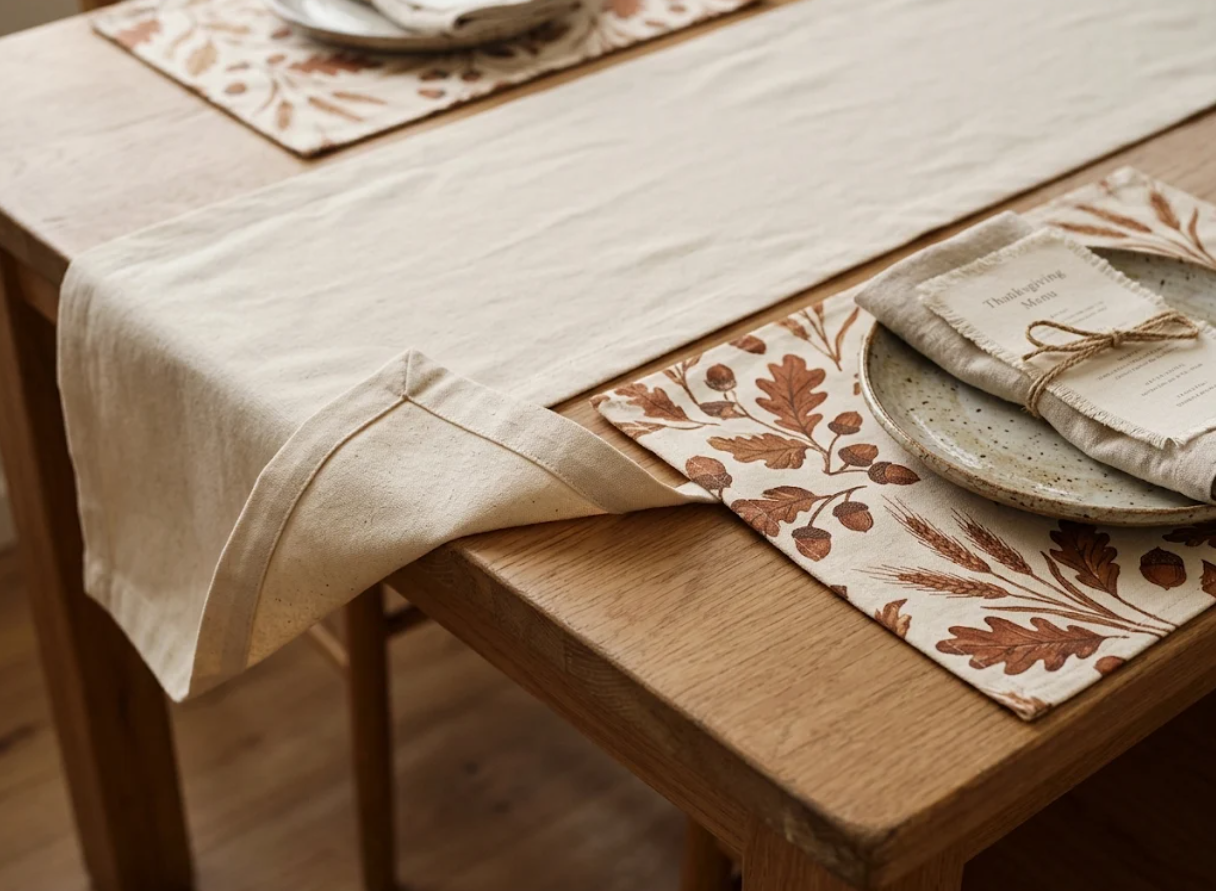
Material: 100% Ring-Spun Cotton | Weight: 10.0 oz/sq yd (339 GSM) | Width: 58–60 in | Weave: 1×1 Single-Fill Plain Weave | Finish: Scoured & Bleached | Coating: Heat-Cured Digital Pigment Ink | End Use: Washable Holiday Placemats & Menu Cards
Custom digitally printed 10 oz bleached cotton duck placemats combine the crisp graphic fidelity of fine letterpress stationery with the washable durability of a 339 GSM woven cotton textile. Through our in-house custom digital pigment printing on cotton duck yardage, home makers, interior designers, and restaurant buyers upload 300 DPI artwork containing autumn botanical illustrations, handwritten family recipes, or personalized Thanksgiving dinner menus nested across a 58-inch printable width. Our print-to-production team also produces coordinating custom wallpaper printing on woven textile wallcovering substrates for dining room accent walls and seasonal hospitality installations.
Material: 100% Plied Cotton | Weight: 14.73 oz/sq yd (#10 Duck, 500 GSM) | Width: 59 in | Weave: 2×2 Plied Numbered Duck | Finish: Vat-Dyed Autumn Tones | Coating: Water-Repellent & Antimicrobial (WRAM) | End Use: Dining Chair Slipcovers
Protecting upholstered dining room chairs from cranberry sauce, red wine, and turkey gravy requires a heavy plied cotton fabric treated with a hydrophobic surface barrier. We specify 59-inch water-repellent and antimicrobial #10 dyed cotton duck (14.73 oz/sq yd, 500 GSM) for seasonal slipcovers because its two-ply warp and weft structure resists seam slippage under seated loads while beading liquid spills on the surface for immediate blotting. Unlike stiff PVC-backed patio covers, WRAM-finished #10 cotton duck retains breathable natural cotton hand-feel for indoor dining comfort.
Material: 100% Plied Cotton | Weight: 18.0 oz/sq yd (#8 Duck, 610 GSM) | Width: 58–60 in | Weave: Multi-Ply Numbered Duck | Finish: Unbleached Natural or Custom Dyed | Coating: Uncoated Steam-Breathable | End Use: Freestanding Roll Warming Basket
An 18 oz Number 8 plied cotton duck bread basket stands upright on the Thanksgiving buffet without plastic or cardboard inserts while allowing excess steam to vent so hot dinner rolls and sourdough boules never turn soggy. At 610 GSM, Number 8 duck provides the highest flexural rigidity of any domestic-sewable cotton canvas, holding crisp 90-degree boxed corners even after repeated folding for flat drawer storage.
Transporting hot Thanksgiving pies, 9×13-inch ceramic casseroles, chilled wine bottles, and split hardwood logs requires high-tensile plied cotton duck ranging from 14.5 oz finished waxed army duck (492 GSM) to 18 oz Number 8 plied duck (610 GSM). Lightweight promotional tote bags (5 oz to 6 oz plain weave) stretch on the bias and tear at the handle bar-tacks under concentrated corner loads, causing pie crusts to crack and hot gravy or fruit fillings to spill during transit.
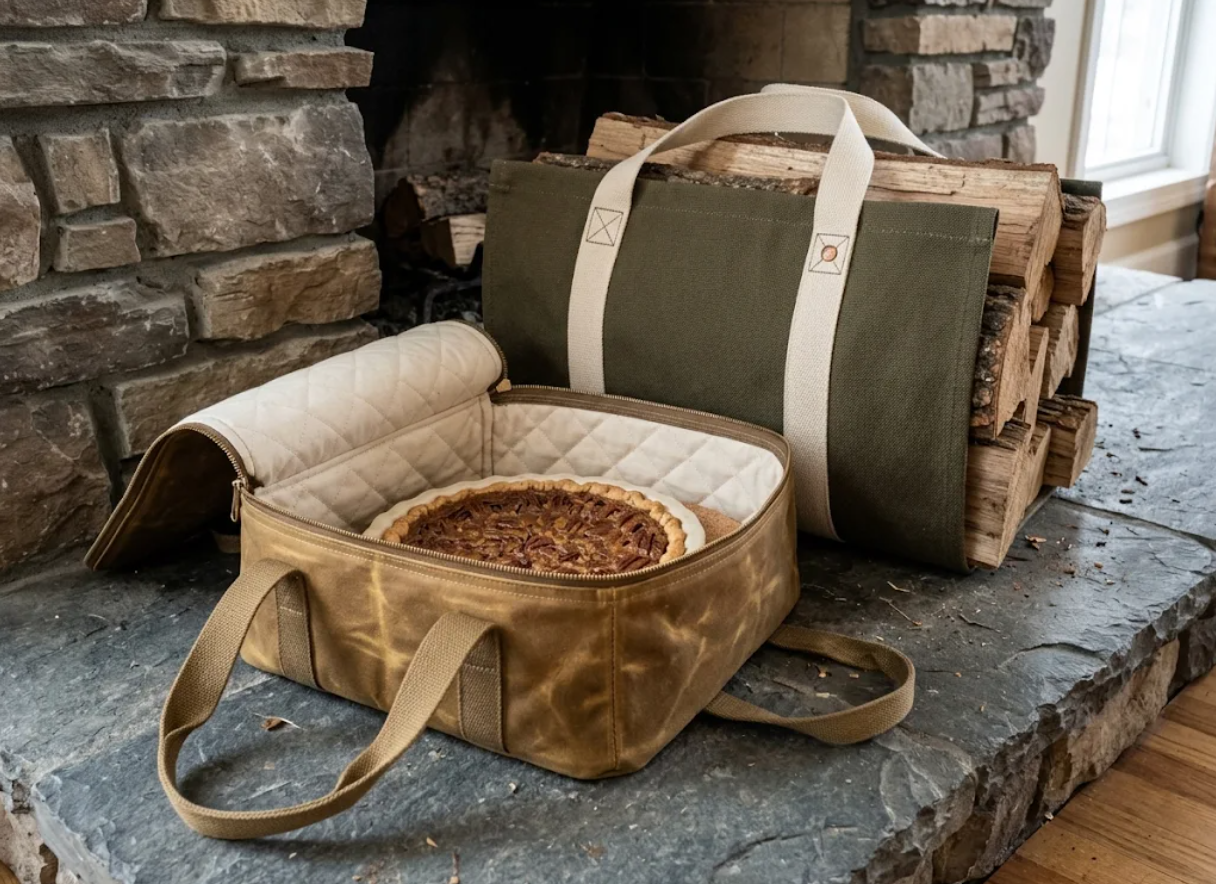
Material: 100% Combed 2-Ply Cotton | Weight: 10.10 oz base / 14.5 oz waxed (492 GSM) | Width: 60 in | Weave: Tight Two-Ply Army Duck | Finish: Vat-Dyed Field Tan | Coating: Paraffin & Beeswax Impregnated | End Use: Insulated Pie & Casserole Carrier
A horizontal double-handle pie and casserole carrier built from 60-inch Field Tan waxed army duck canvas keeps 9-inch deep-dish pies and 9×13-inch stoneware bakers level during car travel while repelling rain, sleet, and accidental filling drips. Army duck is woven from fine, tightly twisted two-ply combed cotton yarns at a higher thread count than standard ounce duck, locking the paraffin-and-beeswax formula inside the fiber matrix.
Material: 100% Combed 2-Ply Cotton | Weight: 10.10 oz base / 14.5 oz waxed (492 GSM) | Width: 60 in | Weave: Tight Two-Ply Army Duck | Finish: Vat-Dyed Oak or Olive | Coating: Paraffin & Beeswax Impregnated | End Use: Padded Two-Bottle Wine & Cider Tote
A two-bottle holiday wine and sparkling cider tote sewn from 14.5 oz waxed army duck (492 GSM, 60-inch width) creates a water-repellent host gift that develops rich amber crease marks (patina) with every folding cycle. Unlike paper gift bags that rip when dampened by condensation on chilled Sauvignon Blanc or hard cider bottles, waxed army duck resists moisture absorption and supports dual 750 mL glass bottles with a wide safety margin.
Material: 100% Plied Cotton | Weight: 18.0 oz/sq yd (#8 Duck, 610 GSM) | Width: 58 in | Weave: Multi-Ply Numbered Duck | Finish: Vat-Dyed Olive Drab | Coating: Uncoated Spark-Resistant | End Use: Hearth Firewood Log Tote
An open-ended fireplace log carrier crafted from 18 oz Number 8 cotton duck (610 GSM, 58-inch width) hauls 35 to 50 pounds of rough-barked white oak, hickory, or birch from outdoor woodpiles to indoor Thanksgiving hearths without snagging or puncturing. Unlike synthetic polypropylene or nylon tarps that melt into hot plastic droplets upon contact with stray hearth embers, 100% cotton #8 duck chars slowly without thermoplastic melting.
Material: 100% Ring-Spun Cotton | Weight: 12.0 oz/sq yd (407 GSM) | Width: 59 in | Weave: 3×1 Right-Hand Bull Denim Twill | Finish: Sanforized & Brushed | Coating: Uncoated Body / Waxed Duck Pockets | End Use: Turkey Carving & Basting Apron
A Thanksgiving chef’s carving and basting apron constructed from 12 oz sanforized brushed cotton bull denim (407 GSM, 59-inch width, 3×1 right-hand twill weave) paired with 14.5 oz waxed army duck chest and hip pockets balances all-day drape with targeted grease defense. While plain-weave #10 duck can feel stiff against the waist during a six-hour turkey roast, 3×1 twill bull denim bends fluidly with torso movement while blocking hot pan splatters.
Archival stretched, slit-roll, and panel-mounted artist canvas projects for Thanksgiving require unprimed or gesso-primed #12 cotton duck (11.5 oz/sq yd, 390 GSM) and #10 cotton duck (14.73 oz/sq yd, 500 GSM) sourced from wide-format 60-inch to 120-inch rolls. Retail discount craft boards rely on loose 4 oz poly-cotton sheeting glued over acidic grayboard cores that warp into concave bows when coated with heavy acrylics, walnut ink, or mixed-media botanicals.
Material: 100% Plied Cotton | Weight: 11.5 oz/sq yd (#12 Duck, 390 GSM) | Width: 72 in | Weave: 2×2 Plied Numbered Artist Weave | Finish: Unprimed Natural | Coating: Clear Archival Acrylic Size | End Use: Hanging Family Gratitude Wall Scroll
An oversized hanging gratitude scroll cut from 72-inch unprimed Number 12 cotton duck artist canvas serves as an heirloom Thanksgiving wall installation where family members and guests write dated reflections every November. At 11.5 oz/sq yd (390 GSM), Number 12 plied cotton duck hangs plumb between top and bottom 1-inch hardwood dowels without curling inward along the vertical edges. For institutional buyers, schools, and makers producing multiple scrolls, our slitting department can slit 72-inch rolls into two 36-inch or three 24-inch continuous widths.
Material: 100% Plied Cotton | Weight: 14.73 oz/sq yd (#10 Duck, 500 GSM) | Width: 72 in | Weave: 2×2 Plied Numbered Artist Weave | Finish: Raw Stretched on 1.5-in Bars | Coating: Triple-Coat Titanium Acrylic Gesso | End Use: Three-Panel Harvest Wall Art
Stretching three matching 24-inch × 36-inch gallery-wrapped panels from a single roll of 72-inch Number 10 cotton duck (14.73 oz/sq yd, 500 GSM) over 1.5-inch kiln-dried basswood stretcher bars produces drum-tight painting supports at less than one-third the cost of pre-stretched retail canvases. Number 10 plied duck resists corner sag across large spans and maintains uniform warp-and-weft tension through seasonal winter heating cycles.
Material: 100% Ring-Spun Cotton | Weight: 7.0 oz/sq yd (237 GSM) | Width: 60 in | Weave: 1×1 Single-Fill Plain Weave | Finish: Vat-Dyed Wheat or Custom Colored | Coating: Heat-Set Screen Ink & Clear Acrylic Sealer | End Use: Mantel Bunting & Porch Banner
For makers, classrooms, and retail visual merchandisers seeking a fast, no-sew holiday build, 7 oz single-fill cotton duck in a 60-inch width (237 GSM, vat-dyed Wheat or custom-colored to brand Pantone specifications) cuts cleanly with pinking shears or a rotary cutter to form triangular mantel bunting and vertical front-porch welcome banners. At 237 GSM, 7 oz duck is light enough to hang from removable adhesive mantel hooks while heavy enough to resist twisting in autumn breezes.
Material: 100% Plied Cotton | Weight: 11.5 oz/sq yd (#12 Duck, 390 GSM) | Width: 60 in | Weave: 2×2 Plied Numbered Artist Weave | Finish: Laminated on 0.75-in Birch Cradle | Coating: Archival PVA & Triple Acrylic Gesso | End Use: Rigid Kids’ Keepsake Art Panel
Laminating 11.5 oz Number 12 plied cotton duck (390 GSM, 60-inch width) onto 0.75-inch cradled Baltic birch plywood panels using pH-neutral polyvinyl acetate (PVA) bookbinding adhesive creates an indestructible rigid support for children’s dated Thanksgiving handprint turkeys, pressed maple leaves, and acorn cap collages. Standard stretched craft-store boards bounce and dent under small hands and sag over time when loaded with heavy glue and 3D natural objects.
Empirical testing at our Auburn, Georgia textile warehouse and cut-and-sew production facility proves that pre-shrinking washable greige cotton duck, matching surface coatings to liquid temperature and acidity, and upgrading needle-and-thread specifications eliminate over 90% of structural and cosmetic failures in Thanksgiving canvas builds. To provide makers and institutional buyers with verifiable benchmarks aligned with AATCC and ASTM consensus standards, our quality assurance team tested four critical holiday failure modes across our stocked cotton duck inventory.
| Test Parameter & Standard | Tested Canvas Specification | Untreated / Control Result | Engineered / Treated Result | Practical Impact on Thanksgiving Projects |
|---|---|---|---|---|
| Relaxation Shrinkage (AATCC TM 135; 120°F wash + tumble dry, $n=30$) | 10 oz Single-Fill Greige Duck (339 GSM) & #12 Plied Duck (390 GSM) | 10 oz Greige: 6.8% warp / 3.4% weft (-7.3 in on a 108-in runner) #12 Plied: 4.9% warp / 2.2% weft | Accordion pre-washed at 105°F + damp-squared on table: 0.6%–0.9% residual change | Prevents post-feast laundering from shrinking a custom-fitted table runner or chair slipcover out of dimensional tolerance. |
| Liquid & Gravy Repellency (AATCC TM 22 Spray Test; 165°F drippings & pH 2.6 cranberry) | 10 oz Natural Duck vs. 14.5 oz Waxed Army Duck vs. #10 WRAM Duck | Untreated 10 oz Duck: Spray Rating 0 (complete wetting in 18 sec) | 14.5 oz Waxed Army Duck: Spray Rating 90 (zero penetration at 45 min) #10 WRAM Duck: Spray Rating 85 | Waxed army duck excels for wipe-clean culinary totes; #10 WRAM duck excels for machine-washable chair slipcovers. |
| Digital Print Crockfastness (AATCC TM 8; 320°F / 180s heat-cured pigment ink) | 10 oz Scoured & Bleached Cotton Duck (339 GSM, 58-in width) | Uncured air-dried craft paint: Wet Crock Grade 2.0 (visible pigment rub-off on napkins) | Heat-cured digital pigment print: Dry Grade 4.5 / Wet Grade 3.8–4.0 after 5 cold washes | Ensures custom-printed Thanksgiving menus and placemats do not rub pigment onto white dinnerware or sleeves. |
| 4-Ply Handle Seam Load (ASTM D1683 / D5034; 4-layer handle junction on 14.5 oz & 18 oz duck) | 14.5 oz Waxed Army Duck (492 GSM) & 18 oz #8 Plied Duck (610 GSM) | 80/12 universal needle + cotton thread: 0.4–0.7 mm needle deflection; seam failure at 62 lbf | 110/18 denim needle + Tex 70 bonded poly + #9 copper rivet: 215 lbf static load without slippage | Prevents handle tear-out when lifting a 12-lb ceramic baker or a 45-lb load of seasoned oak firewood. |
As Table 2 confirms, pre-shrinking washable greige cotton duck removes nearly 90% of loom-tension relaxation shrinkage prior to cutting, while pairing a 110/18 denim needle with Tex 70 bonded polyester thread and copper rivets triples the load capacity of heavy-duty holiday carriers.
Preparing and sewing cotton duck canvas for Thanksgiving projects requires a four-stage workflow: pre-washing washable yardage in loose accordion folds to prevent dye crazing, squaring the damp warp and weft grain before cutting, fitting a reinforced denim needle (size 90/14 to 110/18) with bonded polyester thread, and lengthening stitch density to 7 to 9 stitches per inch (SPI). For brands, event companies, and institutional buyers scaling holiday production, combiningswatch testing with our in-house roll slitting, custom vat coloring, pattern digitizing, and turnkey cut-and-sew services eliminates bottleneck steps.
Four widespread misconceptions cause DIY sewists, artists, and event planners to ruin yardage or choose unsafe materials when building Thanksgiving canvas projects. Correcting these false premises before purchasing fabric protects both your sewing machine and your dining table.
While woven cotton duck canvas is the premier substrate for structured table runners, waxed culinary totes, and wide-format archival wall scrolls, specification-driven textile engineering requires knowing when flax linen, spun polyester, marine and awning fabrics, technical denier synthetics, 1050D/1680D ballistic nylon, 70D/210D ripstop nylon, or mil-spec textiles are superior choices. Because Canvas ETC stocks both traditional cotton ducks and technical synthetics under one roof, we guide makers and institutional buyers to the exact substrate that matches their mechanical and environmental demands.
| Holiday Application | Recommended Cotton Duck Spec | When to Choose an Alternative Substrate Instead | Best Alternative & Technical Trade-Off |
|---|---|---|---|
| Full-Drop Floor-Length Tablecloths & Napkins | 7 oz Single-Fill Cotton Duck (237 GSM, 60-in width, plain weave) | When you require fluid, waterfall corner drape and ultra-soft hand-feel against guests’ skin. | 5.5 oz–7.0 oz Flax Linen (185–235 GSM): Superior moisture wicking and supple drape, but costs 2.5×–3.5× more per yard and creases more sharply than cotton duck. |
| Permanent Uncovered Outdoor Patio & Awning Covers | 10.10 oz Sunforger Army Duck (342 GSM) or 14.5 oz Waxed Army Duck | When outdoor dining canopies, patio cushions, or porch curtains remain exposed to 365-day UV and wet leaf litter. | 9 oz Solution-Dyed Marine & Awning Acrylic or 600D PU-Coated Polyester: Multi-year UV fade and rot immunity, though less breathable for indoor tabletop use. |
| Extreme-Abrasion Catering & Overland Gear Bags | 18 oz Number 8 Plied Cotton Duck (610 GSM, 58-in width) | When commercial catering racks, cast-iron Dutch oven cases, or airline-checked culinary trunks face concrete dragging and wet ground. | 1050D or 1680D Ballistic Nylon (2×2 Basketweave, PU Back-Coated) & Mil-Spec Textiles: 2.5× higher abrasion and tear resistance with zero moisture rot, though synthetic in appearance and sensitive to direct ember contact. |
| Ultralight Packable Grocery & Leftover Liners | 7 oz Single-Fill Cotton Duck (237 GSM, 60-in width) | When you need a featherweight, waterproof wipe-clean inner liner or collapsible pocket tote for Thanksgiving leftovers. | 70D or 210D Urethane-Coated Ripstop Nylon (65–130 GSM): Packs into a 3-inch pouch and blocks liquid leaks completely, though unsuitable for hot cookware contact. |
Furthermore, many makers combine both worlds in hybrid builds—such as pairing a classic 14.5 oz Field Tan waxed army duck exterior shell with a wipe-clean 210D polyurethane-coated ripstop nylon interior spill liner and a 1050D ballistic nylon abrasion-resistant bottom boot.
Even first-quality cotton duck canvas operates within three strict physical boundaries regarding open-flame proximity, entry-level domestic sewing machine torque, and damp post-holiday storage. Respecting these operational limits prevents fire hazards, broken needle shafts, and mildew damage.
A 10 oz single-fill cotton duck canvas (339 GSM) in a 58-inch to 63-inch bolt width is the optimal specification for a Thanksgiving table runner. The 339 GSM plain-weave structure provides sufficient areal mass to lie flat beneath heavy stoneware platters and gravy boats without sliding across polished wood surfaces, while remaining pliable enough to fold crisp 1-inch mitered corners using a domestic sewing machine fitted with a 90/14 or 100/16 denim needle and Tex 40 core-spun polyester thread. By contrast, 7 oz cotton duck (237 GSM) requires starching or backing to prevent bunching, whereas 14.73 oz Number 10 plied duck (500 GSM) creates excessive seam bulk at four-layer mitered corners. Ordering a 63-inch-wide cut of 10 oz natural single-fill cotton duck allows makers to cut three full-length 18-inch × 108-inch runners along the warp grain without a single center piecing seam.
Placing a 350°F to 400°F baking dish directly onto paraffin-treated waxed army duck softens and migrates the wax coating because paraffin and beeswax blends melt between 120°F and 150°F (49°C–66°C). Direct contact with hot Pyrex or cast-iron cookware liquefies the surface wax, transferring an oily residue onto the dish and leaving a pale, depleted ring on the canvas face. To transport hot pies and casseroles safely while maintaining the USDA FSIS 140°F food-safety threshold, construct waxed army duck carriers with a three-layer thermal stack: an exterior shell of 14.5 oz finished waxed army duck (492 GSM), a middle core of needle-punched aluminized polyester thermal batting, and an interior lining of unbleached 10 oz single-fill cotton duck (339 GSM) paired with a removable 0.25-inch cork trivet base.
Order 8% to 10% extra linear yardage—roughly 3 to 3.5 additional inches per linear yard—when purchasing unwashed natural greige cotton duck for washable Thanksgiving table runners, placemats, or chair slipcovers. Per AATCC Test Method 135 home laundering trials conducted at our Auburn, Georgia textile facility across 30 specimens, unwashed 10 oz single-fill cotton duck contracts by 6.8% along the warp direction and 3.4% across the weft direction during its first 120°F wash and tumble-dry cycle, while tighter two-ply Number 12 cotton duck (11.5 oz/sq yd, 390 GSM) contracts by 4.9% in the warp and 2.2% in the weft. Pre-washing yardage in loose accordion folds at 105°F and pressing the fabric flat while 15% damp removes nearly 90% of loom relaxation tension, keeping post-dinner laundering shrinkage below 0.9%.
Single-fill ounce duck (such as 7 oz or 10 oz cotton duck) weaves two warp yarns over a single weft yarn in a 1×1 plain weave, producing a pliable, economical fabric suited for draped table runners, printed placemats, napkins, and hanging porch banners. Numbered duck (such as #12 at 11.5 oz/sq yd, #10 at 14.73 oz/sq yd, or #8 at 18.0 oz/sq yd) uses multi-ply twisted cotton yarns in both the warp and weft directions, creating a denser, stiffer basket-plain weave structure where lower grade numbers indicate heavier fabric ($\text{Number} = 19 – \text{ounces per } 22\text{-in} \times 36\text{-in yard}$). Choose single-fill ounce duck whenever a holiday project requires crisp folding and domestic machine hemming; choose plied numbered duck when a build requires freestanding wall stiffness (such as #8 duck bread baskets), high tensile tear strength (#8 duck log carriers), or warp-free wide-format painting and lettering spans (#12 and #10 artist duck).