
Ballistic nylon is a high-tenacity Polyamide 6,6 fabric engineered with a balanced 2×2 basket weave that delivers exceptional tensile and tear resistance. Because its porous weave allows moisture penetration under hydrostatic pressure, true waterproofness requires a knife-coated polyether polyurethane (PU) or TPU backing paired with an exterior durable water repellent (DWR) face finish.
At Canvas ETC, we supply commercial rolls, custom slitting, and full cut-and-sew contract manufacturing for high-performance textiles. Across decades of testing in our Georgia fabrication facility, gear designers, defense contractors, and industrial bag makers regularly ask us how to balance weave flexibility against total moisture exclusion. To make specification decisions simple, here are the foundational engineering rules governing ballistic nylon:
Ballistic nylon utilizes a balanced 2×2 basket weave where two warp ends float over and under two filling picks simultaneously. This paired geometry provides superior yarn mobility, allowing adjacent filaments to shift and bunch together when subjected to tearing forces, yielding up to 138 lbf Elmendorf tear resistance (ASTM D1424) without sacrificing surface smoothness.
Originally synthesized and woven by DuPont during World War II under federal research contracts, ballistic nylon was engineered for airmen flak jackets to catch high-velocity lead flak and shell fragments. While modern ballistic vests rely on rigid ceramics and ultra-high-modulus para-aramids like Kevlar, the mechanical architecture of ballistic nylon remains the gold standard for rugged commercial luggage, tactical load-bearing vests, motorcycle apparel, and heavy tool bags.
To understand why this weave performs so exceptionally under mechanical stress, we must look at how yarn interlacing distributes dynamic kinetic energy:
    WARP PAIR 1     WARP PAIR 2
       │   │           │   │
───────┼───┼───────────▀───▀─────── WEFT PAIR 1 (Over Warp 2, Under Warp 1)
───────┼───┼───────────▀───▀───────
       │   │           │   │
───────▀───▀───────────┼───┼─────── WEFT PAIR 2 (Over Warp 1, Under Warp 2)
───────▀───▀───────────┼───┼───────
       │   │           │   │
In a conventional 1×1 plain weave (such as standard canvas or Oxford cloth), every single yarn alternates over and under adjacent perpendicular yarns at every intersection. This creates a high frequency of crimp bends per linear inch, locking the yarns firmly into fixed grid positions. When a sharp puncture or tear initiates in a 1×1 plain weave, the stress isolates entirely onto a single thread. The tearing force breaks that thread, advances to the next thread, and propagates rapidly across the fabric.
In our balanced 2×2 basket weave, the frequency of yarn interlacing points is halved. Because pairs of warp and weft yarns float together across two intersections, the individual continuous filaments possess freedom of movement—a mechanical property known as yarn mobility:
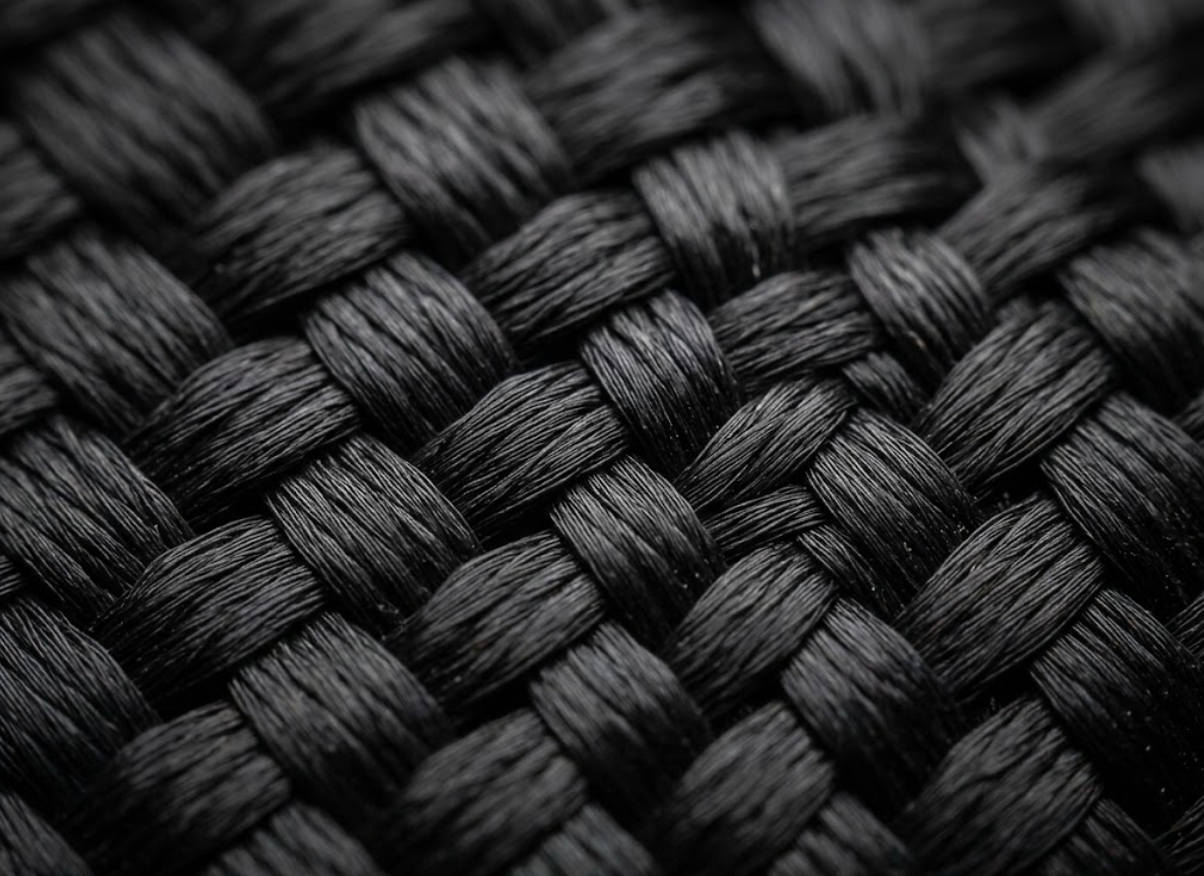
The 2×2 architecture also minimizes yarn stress degradation during weaving. In tight plain weaves, the aggressive over-under crimp reduces the effective tensile strength of high-tenacity yarns by up to 15% due to shearing at the intersection apex. The smoother, elongated floats of the 2×2 basket weave reduce crimp angles, allowing the continuous-filament Polyamide 6,6 yarns to operate closer to their theoretical maximum tensile tenacity (9.0 g/d).
In our commercial 1050 denier ballistic nylon fabric, our construction features a thread count of 34 warp ends by 30 filling picks per inch (ASTM D3775). This balanced crimp distribution ensures virtually isotropic strength across both axes: 530 lbf grab tensile strength in the warp and 485 lbf in the fill (ASTM D5034). If you are exploring how weave structures differ across high-denier fabrics, review our comprehensive guide to denier fabric weave types.
Genuine 1050D ballistic nylon is woven from single-ply, continuous-filament high-tenacity Nylon 6,6 yielding a fiber tenacity of 8.5 to 9.5 g/denier. Conversely, commercial 1680D is commonly woven from two plies of lower-grade Nylon 6 (5.5–6.5 g/d). Consequently, 1050D fabric delivers 35% higher tensile grab strength (ASTM D5034) and substantially greater abrasion resistance.
One of the most persistent procurement misconceptions in the textile industry is the belief that higher denier numbers always equal a stronger fabric. Purchasing agents frequently assume that 1680D ballistic nylon must be 60% stronger than 1050D simply because 1680 is greater than 1050. In production reality, this number refers strictly to linear mass density (the weight in grams of 9,000 meters of yarn), revealing nothing about polymer chemistry, tensile tenacity, or filament orientation.
Authentic 1050D is extruded exclusively from Polyamide 6,6 (synthesized from hexamethylenediamine and adipic acid). Polyamide 6,6 contains a highly symmetrical molecular chain structure with dense, regularly spaced hydrogen bonds between adjacent carbonyl (C=O) and amino (N-H) groups. This crystalline morphology gives it a melting point of 255°C to 265°C (491°F to 509°F) and extreme mechanical resilience.
In contrast, commercial 1680D is almost universally extruded from commodity Polyamide 6 (synthesized via the ring-opening polymerization of caprolactam). Polyamide 6 features lower molecular alignment, lower hydrogen bond density, and a significantly lower melting threshold of 215°C to 220°C (419°F to 428°F). The resulting fiber tenacity is only 5.5 to 6.5 g/d, representing a ~35% deficit in base polymer strength compared to high-tenacity Nylon 6,6.
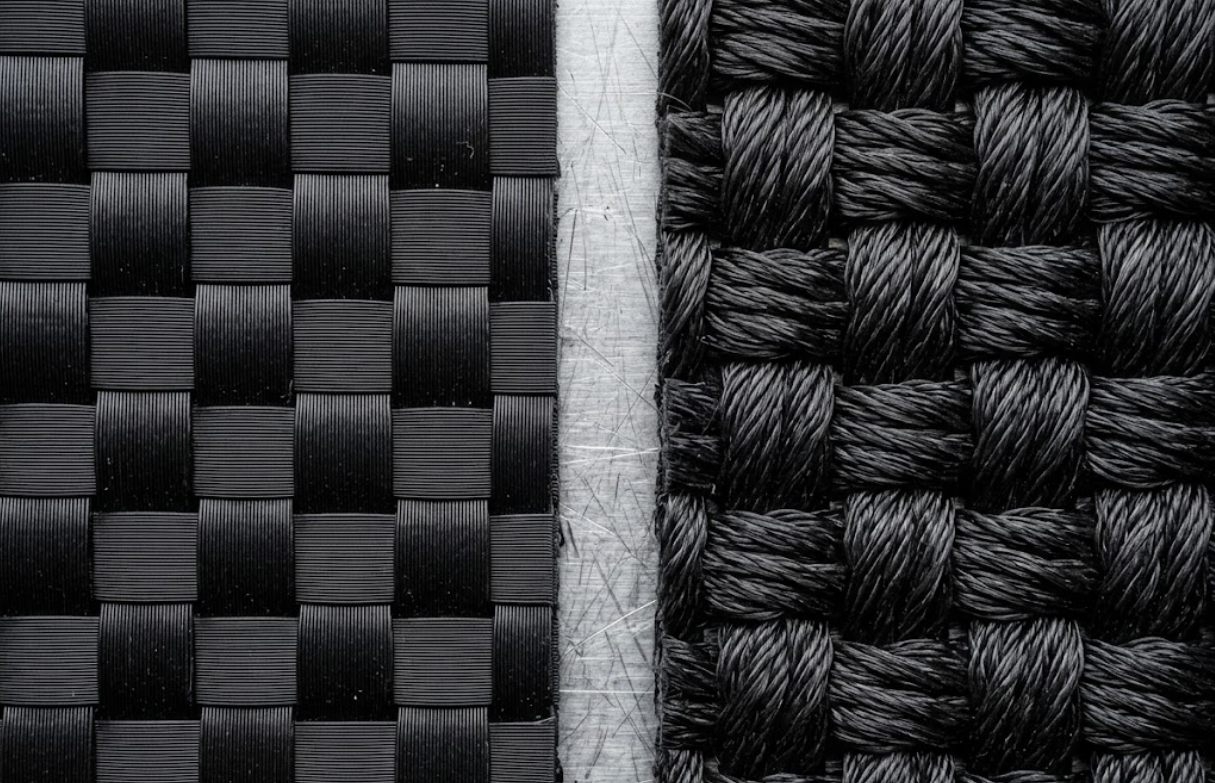
In genuine 1050D, each warp and filling yarn is a single continuous filament bundle. When woven into a 2×2 basket weave, these smooth filament bundles pack closely together, creating a tight surface profile with exceptional rotary abrasion resistance under ASTM D3884 testing (>2,800 cycles to wear-through on a Taber H-18 wheel).
Commercial 1680D is constructed by twisting two plies of 840-denier yarn together (2 x 840D = 1680D). When these plied yarns are woven, the twisted geometry creates tall microscopic ridges and valleys on the fabric surface. Under abrasive contact, friction concentrates exclusively on the raised crowns of the twisted yarns, causing them to abrade prematurely, fuzz, and sever. In Taber abrasion testing, commercial 1680D typically fails at just 1,400 cycles—roughly half the working lifespan of 1050D.
For deep-dive comparisons of nylon polymer classes and denier selections, read our article on the composition and history of ballistic nylon and our practical overview on how to choose the right denier fabric.
Uncoated ballistic nylon is not waterproof because the 2×2 basket weave contains macroscopic interstitial voids between yarn bundles ranging from 20 to 60 microns in diameter. In addition, hydrophilic amide groups in polyamide fibers absorb up to 4% moisture by weight, allowing water to pass through under minor hydrostatic pressures below 100 mm H₂O.
A frequent inquiry we receive from emerging gear brands is whether an extra-heavy, ultra-tight nylon weave can repel water without chemical coatings. The laws of fluid dynamics and polymer thermodynamics provide a definitive answer: No woven textile constructed from continuous-filament synthetic yarns can be waterproof without a non-porous polymer backing or membrane barrier.
Even when woven on modern high-speed rapier looms at maximum warp and pick tension, intersecting 1050-denier yarn bundles cannot achieve zero clearance. The circular cross-section of multi-filament yarns inevitably creates interstitial voids—microscopic tunnels between adjacent threads:
Unlike chemically inert hydrophobic polyolefins (such as polyethylene or polypropylene), polyamide (nylon) contains polar amide groups (-CONH-) distributed along its polymer backbone. These polar groups form hydrogen bonds with water molecules, causing raw nylon fibers to absorb between 3.5% and 4.5% moisture by weight under ambient conditions.
When rain strikes uncoated ballistic nylon, the polar amide groups attract water, causing the continuous filaments to wet out rapidly. The tight parallel channels between the hundreds of microscopic filaments comprising each 1050-denier bundle act as capillary pumps, drawing water deep into the yarn core and transporting it across the thickness of the fabric. In laboratory hydrostatic testing per AATCC 127, untreated greige 1050D ballistic nylon exhibits continuous water droplet breakthrough at pressures below 80 mm H₂O (approx. 0.11 PSI). Within minutes, pressurized moisture saturates the reverse side.
Polyurethane back-coatings seal ballistic nylon by depositing a thin, continuous elastomer film onto the fabric underside, delivering 1,000 to 2,000 mm H₂O hydrostatic resistance (AATCC 127). Fabricators must specify polyether-based PU rather than cheaper polyester-based PU, as polyester urethanes undergo moisture-induced hydrolysis over 3 to 5 years, resulting in sticky delamination, flaking, and severe odor release.
To achieve water impermeability, chemical finishers apply a continuous polymer barrier to the underside (back) of the fabric. This layer bonds to the woven filaments, bridges the 20–60 micron interstitial pores, and forms an impenetrable solid-state barrier. In commercial manufacturing, three distinct polymer coating technologies dominate: Polyurethane (PU), Thermoplastic Polyurethane (TPU) Film, and Polyvinyl Chloride (PVC).
Polyurethane is applied via a knife-over-roll coating machine, where liquid urethane resin dissolved in solvent or waterborne dispersion is spread across the moving fabric web, then cured in a multi-stage convective drying oven.
However, not all polyurethane coatings are engineered equally. In commercial textiles, polyurethane resins are divided into two fundamental chemical classes:
Laboratory Case Study 1: Accelerated Tropical Hydrolytic Aging (ISO 1419 Method C)
To definitively evaluate hydrolytic resilience for our contract manufacturing partners, the Canvas ETC testing facility conducted an accelerated environmental degradation trial comparing polyester-based and polyether-based PU coatings on 1050D ballistic nylon:
At Canvas ETC, we exclusively engineer and stock specification-grade ballistic nylon formulated with polyether polyurethanes to prevent field failures. For more technical background on polymer films, see our dedicated article on protective denier fabric coatings.
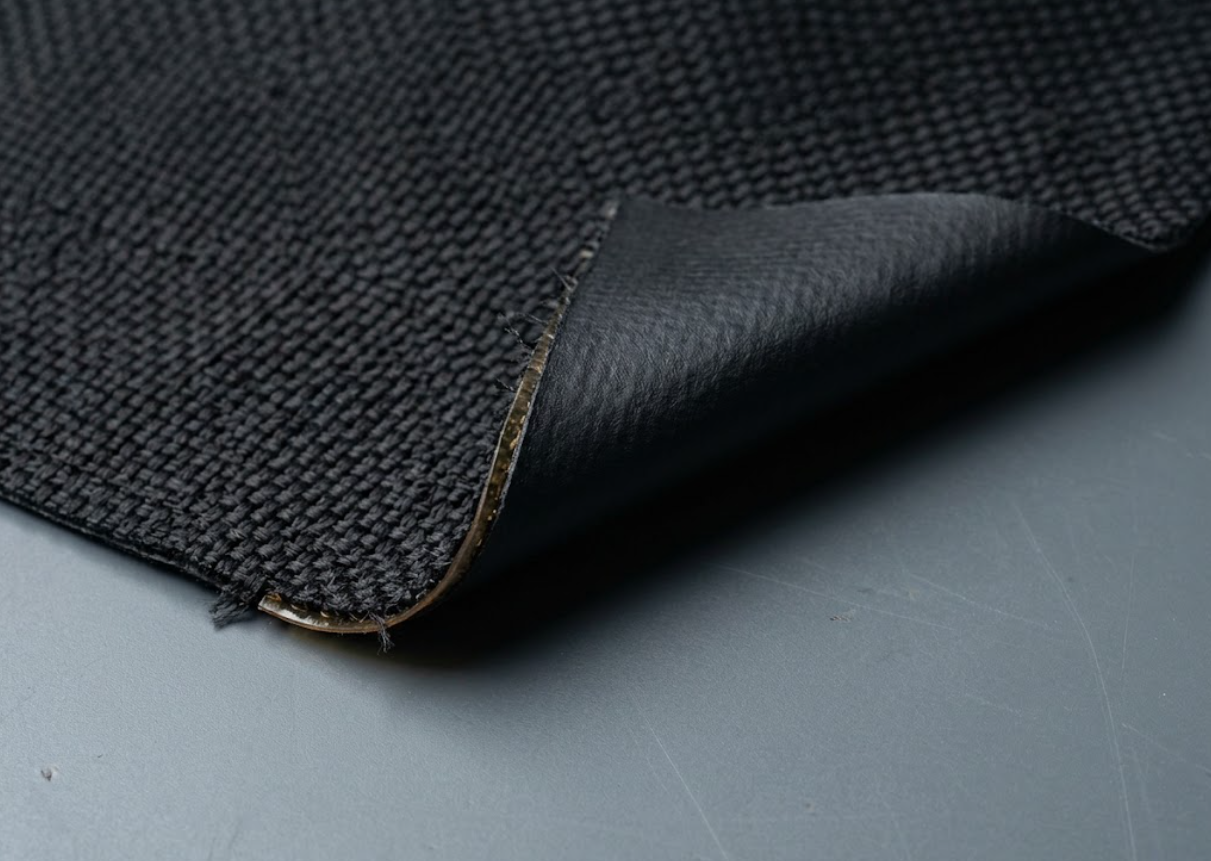
For applications demanding total fluid containment, airtight inflation, or marine submersion (such as military dry bags, tactical pack rafts, and hazardous material duffels), standard knife-coated PU is superseded by Thermoplastic Polyurethane (TPU) film lamination.
Rather than spreading a liquid resin, an extruded 1.0 to 3.0 mil (0.025 mm to 0.075 mm) solid elastomeric TPU film is thermally bonded directly onto the ballistic nylon using heated nip rollers. TPU laminations deliver extreme hydrostatic resistance exceeding 10,000 to 20,000 mm H₂O. Because TPU is a thermoplastic, finished panels can be permanently joined using Radio Frequency (RF) welding or ultrasonic thermal bonding, eliminating stitched needle holes entirely to create 100% airtight and watertight seams.
Polyvinyl chloride (PVC) is a heavy synthetic plastisol applied via calendar roll coating. PVC deposits a thick, dense, rubberized barrier (typically adding 4.0 to 6.0 oz/yd² to the fabric weight). While it delivers complete waterproofness (>10,000 mm H₂O) and extreme puncture resistance at a low commercial cost, PVC coatings contain liquid plasticizers that gradually leach out over time. In low-temperature testing per ASTM D2136, PVC backings exhibit severe cold-cracking at -15°C to -20°C (5°F to -4°F), shattering under flexural stress.
Durable water repellent (DWR) finishes lower the exterior surface energy of ballistic nylon below that of water, achieving an initial AATCC 22 spray rating of 90 to 100. While legacy short-chain C6 fluorocarbons repel both oil and water, modern fluorine-free C0 finishes effectively bead water but require precise thermal curing and offer zero oil repellency.
While an internal back-coating stops water from penetrating through to the interior of a bag, it does not prevent water from saturating the exterior woven face. When untreated face fibers absorb water, the fabric undergoes “wetting out”: the textile gains up to 25% additional dead water weight, porous interstitial cavities fill with water, and continuous moisture contact creates sustained hydrostatic pressure against the back-coating.
A Durable Water Repellent (DWR) is an ultra-thin chemical finish applied via an aqueous pad-bath, squeezed through high-pressure padder rolls, and cross-linked in a curing oven at 160°C to 180°C. DWR finishes functionalize the individual filament surfaces, lowering their critical surface energy far below the surface tension of water (72.8 mN/m):
Polyamide 6,6 is naturally vulnerable to photodegradation when exposed to terrestrial solar ultraviolet radiation (UV-A and UV-B wavelengths between 290 and 400 nm). UV photons break covalent bonds in the polyamide backbone through photo-oxidation, leading to yellowing, embrittlement, and a steady loss of tensile strength over extended outdoor exposure. To ensure multi-year field longevity in awnings, marine covers, and expedition backpacks, our finishing baths incorporate Hindered Amine Light Stabilizers (HALS) and Benzotriazole UV Absorbers.
For aviation interiors, military protective gear, and institutional applications, ballistic nylon can be finished with durable flame-retardant chemistries complying with NFPA 701 (Method 1 & 2), CPAI-84, or FAR 25.853. Modern non-halogenated organophosphorus FR additives are incorporated into the back-coating or pad-applied to promote rapid char formation, self-extinguishing the textile within two seconds of flame removal. Compare this synthetic performance with natural cellulosic textiles in our analysis of Cordura vs. cotton duck canvas durability.
Applying a heavy polymer back-coating to ballistic nylon reduces its dynamic Elmendorf tear strength (ASTM D1424) by 10% to 35% through yarn locking. When resin penetrates deep into the 2×2 weave, it prevents adjacent filament bundles from shifting together to dissipate tearing energy, concentrating mechanical shear stress directly onto individual fibers at the tear point.
One of the most vital principles we emphasize to OEM gear designers is that fabric engineering is a discipline of trade-offs. Applying a coating to improve water resistance inevitably alters the physical mechanics of the underlying weave.
Laboratory Case Study 2: Yarn Mobility vs. Coating Mass & Penetration (ASTM D1424 vs. ASTM D751)
In the Canvas ETC quality control lab, our engineers benchmarked three production variations of our 1050D Nylon 6,6 greige substrate to quantify the exact mechanical penalty of differing coating technologies:
ELMENDORF TEAR STRENGTH vs. COATING TECHNOLOGY (ASTM D1424)
──────────────────────────────────────────────────────────────────────────
Greige Uncoated 1050D:       ████████████████████████████ 138 lbf (Baseline)
Double-Pass Polyether PU:    ████████████████████████ 121 lbf (-12.3%)
Heavy Calendered PVC:        ███████████████████ 95 lbf (-31.1%)
Commercial 1680D (2-ply PU): ███████████████ 78 lbf (-43.5%)
──────────────────────────────────────────────────────────────────────────
Coating weight also directly dictates the flexural rigidity (stiffness) and drape of the finished fabric. While a 0.75 oz/yd² polyether PU coating leaves the fabric supple enough for complex curved patterns and tight seams on walking-foot machines, heavy PVC backings create extreme stiffness that resists manipulation, requiring oversized seam allowances and leading to operator fatigue.
Fabricating PU-coated 1050D ballistic nylon requires an industrial walking-foot sewing machine fitted with System 135×17 (DPx17) acute round-point needles in sizes 18/110 to 22/140 to prevent cutting load-bearing yarns. Seams should be sewn with Tex 90 or Tex 138 bonded polyamide thread and sealed using 3-layer hot-air polyurethane tape applied at 420°C and 2.5 bar pressure.
Even the highest-grade, laboratory-certified waterproof ballistic nylon will fail in the field if workshop fabrication protocols are flawed. Every needle penetration punches a hole through both the woven substrate and the polymer barrier membrane. Drawing from Canvas ETC’s active commercial cut-and-sew and finished-goods production lines, here are the non-negotiable manufacturing specifications for fabricating coated ballistic nylon:
The single most common error made by workshops transitioning from leathercraft to technical textiles is using leather-point needles (System 135×16 DIA / Tri-Point / Wedge). Cutting-point needles feature razor-sharp edges designed to slice through solid, non-fibrous animal hides. When plunged into 1050D ballistic nylon, the knife-edges cleanly sever the high-tenacity continuous filaments inside each yarn bundle and slice wide puncture slots through the PU membrane. Under seam tension, these sliced yarns unravel, cutting the seam’s tensile strength in half and creating severe water leaks.
You must exclusively use System 135×17 (DPx17) acute round-point needles (R). A round point slips smoothly between the tightly woven continuous filaments, gently nudging them aside without cutting. Because polyamide is elastic, the displaced filaments snap back tightly against the inserted thread, minimizing the diameter of the puncture hole. Use Size 18/110 for 2 to 3 fabric plies, and step up to Size 22/140 for heavy multi-layer structural joints (such as webbing attachments).
High-tenacity ballistic nylon demands thread that matches its tensile tenacity and abrasion resistance. Standard apparel threads will snap or shred under friction:
Laboratory Case Study 3: Seam Puncture Geometry & Seam Tape Hydrostatic Integrity
Our cut-and-sew division performed hydrostatic testing on 1050D PU-coated panels clamped in a Pullen tester directly across flat-felled sewn seams:
Need complementary technical fabrics for internal linings, divider pockets, or tear-resistant reinforcing baffles? Review our commercial inventory of 1000 denier nylon fabric, 500 denier Cordura nylon, and ultralight 70 denier ripstop nylon fabric.
To streamline material evaluation for purchasing managers, military contractors, and materials engineers, Canvas ETC has compiled the definitive master engineering comparison matrix below. All metrics are standardized across official ASTM, AATCC, ISO, and Federal testing standards:
| Performance Property | Governing Standard | 1050D Raw Greige | 1050D + Polyether PU | 1050D + TPU Film | 1050D + Calendered PVC | Commercial 1680D + PU |
|---|---|---|---|---|---|---|
| Polymer Chemistry | FTIR Analysis | Polyamide 6,6 | Polyamide 6,6 | Polyamide 6,6 | Polyamide 6,6 | Polyamide 6 |
| Yarn Configuration | ASTM D1059 | 1050D Single-Ply | 1050D Single-Ply | 1050D Single-Ply | 1050D Single-Ply | 2-Ply Twisted (2x840D) |
| Fiber Tenacity | DuPont Spec | 8.5 – 9.5 g/d | 8.5 – 9.5 g/d | 8.5 – 9.5 g/d | 8.5 – 9.5 g/d | 5.5 – 6.5 g/d |
| Weave Architecture | ASTM D3775 | 2×2 Basket Weave | 2×2 Basket Weave | 2×2 Basket Weave | 2×2 Basket Weave | 1×1 Plain / 2×2 Plied |
| Thread Count (EPI x PPI) | ASTM D3775 | 34 x 30 | 34 x 30 | 34 x 30 | 34 x 30 | 28 x 26 |
| Finished Areal Mass | ASTM D3776 | 13.0 oz/yd² (440 GSM) | 13.8 oz/yd² (468 GSM) | 14.8 oz/yd² (502 GSM) | 17.5 oz/yd² (593 GSM) | 14.2 oz/yd² (481 GSM) |
| Tensile Grab Strength (Warp) | ASTM D5034 | 530 lbf (2,357 N) | 520 lbf (2,313 N) | 515 lbf (2,290 N) | 490 lbf (2,179 N) | 390 lbf (1,735 N) |
| Tensile Grab Strength (Fill) | ASTM D5034 | 485 lbf (2,157 N) | 475 lbf (2,113 N) | 470 lbf (2,090 N) | 450 lbf (2,001 N) | 340 lbf (1,512 N) |
| Elmendorf Tear Resistance | ASTM D1424 | 138 lbf (614 N) | 121 lbf (538 N) | 114 lbf (507 N) | 95 lbf (422 N) | 78 lbf (347 N) |
| Taber Rotary Abrasion (H-18) | ASTM D3884 | 2,800 cycles | 3,100 cycles | 3,300 cycles | 2,200 cycles | 1,400 cycles |
| Hydrostatic Resistance | AATCC 127 | <80 mm H₂O | 1,650 mm H₂O | >10,000 mm H₂O | >10,000 mm H₂O | 1,200 mm H₂O |
| AATCC 22 Spray Rating | AATCC 22 | 0 (Wets out) | 90–100 (DWR Face) | 90–100 (DWR Face) | 90–100 (DWR Face) | 80–90 (DWR Face) |
| Hydrolytic Lifespan | ISO 1419 Method C | >15 Years | >12 Years (Polyether) | >15 Years | 5–8 Years (Stiffens) | 3–5 Years (Polyester PU) |
| Low-Temp Cold Crack | ASTM D2136 | -50°C (-58°F) | -40°C (-40°F) | -40°C (-40°F) | -15°C to -20°C (5°F) | -30°C (-22°F) |
| Recommended Needle System | Factory Tooling | System 135×17 (R) | System 135×17 (R) | System 135×17 (R) | System 135×17 (R) | System 135×17 (R) |
| Recommended Thread Size | Factory Tooling | Tex 90 / Tex 138 | Tex 90 / Tex 138 | Tex 90 / Tex 138 | Tex 138 | Tex 70 / Tex 90 |
| Seam Sealing Protocol | Production SOP | N/A | Hot-Air PU Tape (420°C) | RF / Ultrasonic Weld | RF / Thermal Wedge | Hot-Air PU Tape (390°C) |
Canvas ETC is an established wholesale textile supplier, coating converter, and custom production partner headquartered in Georgia. We serve makers, independent brands, military contractors, and global manufacturers with raw materials and finished-goods cut-and-sew production.
What sets Canvas ETC apart in the technical textile landscape is our seamless integration of canvas authority, technical-fabric expertise, and print-to-production capability in a single source:
Ballistic nylon is constructed using a balanced 2×2 basket weave (matt weave), in which two warp ends float together over and under two filling picks in pairs. This structural geometry allows yarn bundles to shift and bunch under tearing stress, providing superior Elmendorf tear resistance (up to 138 lbf per ASTM D1424) while maintaining a smooth, lustrous surface profile.
No. Raw ballistic nylon is not waterproof. The 2×2 basket weave contains macroscopic interstitial voids between yarn bundles ranging from 20 to 60 microns in diameter. In addition, polyamide 6,6 fibers are inherently hydrophilic, absorbing up to 4% moisture by weight. Under minimal hydrostatic pressure (below 100 mm H₂O), liquid water easily penetrates uncoated ballistic nylon via capillary action.
Genuine 1050D ballistic nylon is woven from single-ply, continuous-filament high-tenacity Nylon 6,6, which possesses a fiber tenacity of 8.5 to 9.5 grams per denier. In contrast, commercial 1680D is almost always woven from two plies of lower-tenacity Nylon 6 (5.5 to 6.5 g/d). Consequently, 1050D fabric delivers 35% higher tensile grab strength (ASTM D5034) and greater tear resistance despite its lower nominal denier number.
Polyether-based polyurethane coatings utilize ether linkages that resist water-induced chemical breakdown, remaining stable for well over 10 years even in humid environments. In contrast, polyester-based polyurethane coatings contain ester bonds that cleave when exposed to ambient moisture and heat (ester hydrolysis), causing the coating to become sticky, flake off, and emit a sour odor after 3 to 5 years.
When fabricating PU-coated 1050D ballistic nylon, use an industrial walking-foot sewing machine equipped with System 135×17 (DPx17) acute round-point needles in sizes 18/110 to 22/140. Cutting-point leather needles should be avoided as they sever structural filaments. Pair the needle with Tex 90 or Tex 138 bonded polyamide or polyester thread at 5 to 6 stitches per inch.
No. Household iron-on tapes lack the adhesive melt temperature and thickness required to penetrate the heavy 2×2 basket weave. Coated ballistic nylon seams must be sealed using 3-layer polyurethane hot-air seam-sealing tape applied with commercial hot-air equipment at 410°C to 430°C and 2.0 to 2.5 bar roller pressure.